

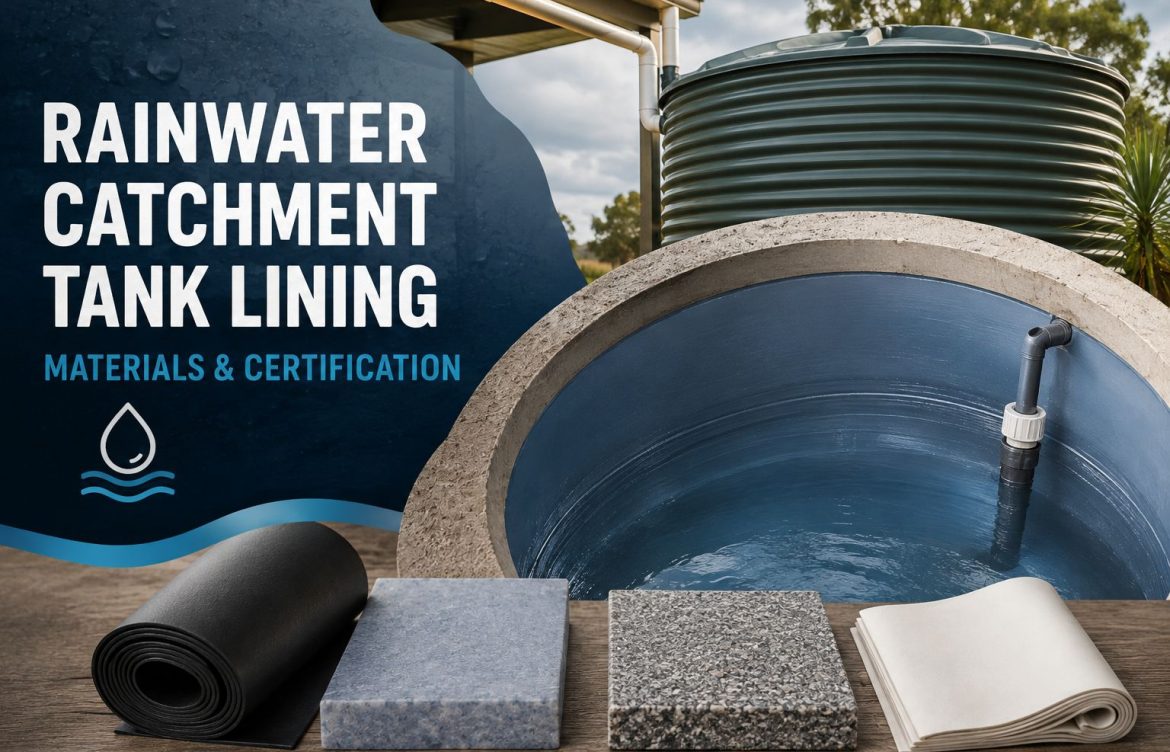
Lining Rainwater Catchment Tanks: Materials and Certification
Rainwater catchment has quietly become a serious part of how a lot of properties handle water, whether that’s a homeowner supplementing a well, a farm operation collecting runoff for irrigation, or a rural property building in some independence from a municipal supply. Once someone decides to build or upgrade a catchment tank, the liner material question comes up fast, and it’s a bigger decision than it first appears.
This guide walks through the main liner material options for rainwater catchment tanks, what actually separates them, and what certification means, and doesn’t mean, once drinking water enters the picture.
Understanding the Basics
A rainwater catchment tank collects and stores runoff, typically from a roof, for later use. What that water is used for changes almost everything about the lining decision. Irrigation and livestock water have real but different requirements than water intended for a household tap, and the liner material that’s perfectly fine for one use case can be entirely wrong for another.
Tank material itself, whether concrete, steel, or a plastic cistern, also factors in. A liner needs to bond to or fit the substrate it’s protecting, and some liner types work better with certain tank materials than others.
Common Liner Material Types
EPDM and rubber membrane liners are a long-standing option, particularly for larger catchment systems. They’re flexible, relatively straightforward to install as a fitted membrane rather than a sprayed or bonded coating, and have a solid track record in the water storage world. The tradeoff is that seams and fitting around tank penetrations require careful installation, since a membrane liner depends on a clean physical fit rather than a chemical bond to the substrate.
Spray-applied polyurethane and polyurea coatings bond directly to the tank surface, creating a seamless interior with no membrane edges or seams to fail. This category tends to handle irregular tank shapes and existing structural imperfections well, since the coating follows the actual contour of the surface rather than needing to be cut and fitted like a membrane.
Epoxy coatings are another bonded option, generally more rigid than a polyurea or polyurethane system, which can make them a reasonable fit for tanks with less structural movement but a less ideal choice where the tank itself flexes or shifts seasonally.
Food-grade plastic liners, often used in smaller or prefabricated tank systems, are pre-manufactured to fit standard tank shapes and sizes, offering a more turnkey installation compared to a coating applied on site.
None of these categories is universally “the best” option. Each fits a different combination of tank material, budget, installation timeline, and end use.
What Certification Actually Means
This is where a lot of confusion happens, and it’s worth being precise about it rather than glossing over it.
If water from the catchment tank is intended for drinking, the liner material needs to carry a verified NSF/ANSI 61 certification, and critically, that certification needs to apply to the exact product being used, not just to “polyurea coatings” or “EPDM liners” as a general category. Certification is granted to specific formulations under specific product names, not to entire material categories. A liner material that sounds similar to a certified product is not the same thing as being certified itself.
For catchment systems used for irrigation, livestock watering, or other non-potable purposes, the certification bar is generally lower, though local and state regulations on rainwater harvesting vary and are worth checking for the specific property’s jurisdiction rather than assumed to be uniform.
The practical takeaway: before choosing a liner material for a tank that will supply drinking water, get written confirmation of NSF/ANSI 61 certification for that exact product, directly from the manufacturer, rather than relying on general marketing language about a coating being “safe” or “food-grade.”
Liner Material Comparison
| Material | Application Method | Best Fit | Consideration |
|---|---|---|---|
| EPDM/rubber membrane | Fitted membrane installation | Larger tanks, established systems | Seam and penetration fitting needs careful installation |
| Polyurea/polyurethane spray coating | Bonded, sprayed application | Irregular shapes, existing structural imperfections | Requires proper surface prep for good adhesion |
| Epoxy coating | Bonded, sprayed or brushed application | Tanks with minimal structural movement | More rigid, less forgiving of substrate flex |
| Food-grade plastic liner | Pre-manufactured fitted liner | Standard-sized, prefabricated tank systems | Less flexible for custom or irregular tank shapes |
Choosing the Right Material for Your Use Case
For potable household water: prioritize a verified NSF/ANSI 61 certification for the exact product first, and let installation method and cost be secondary considerations, since no other factor matters if the certification isn’t confirmed in writing.
For irrigation or livestock use: durability, cost, and fit for the specific tank material tend to matter more than certification, though checking state-level rainwater harvesting regulations is still worth doing before installation.
For an irregular or older tank with structural imperfections: a bonded spray-applied coating often handles the actual shape of the tank better than a fitted membrane, which depends on a cleaner, more regular surface to install properly.
For a deeper look at how liner repair and relining decisions get made once a tank is already in service, our recent guide on repairing and relining underground water storage covers that process in more detail.
Things to Consider Before Choosing a Liner
- What is the water actually going to be used for, drinking, irrigation, livestock, or a mix?
- If drinking water is involved, has NSF/ANSI 61 certification for the exact product been confirmed in writing?
- What tank material and shape are you working with, and does that favor a fitted membrane or a bonded coating?
- What do local or state regulations require for rainwater catchment systems in your specific area?
- Is the installer experienced with the specific liner material being considered, since installation quality affects performance as much as material choice does?
Installation and Long-Term Performance
Liner performance depends heavily on installation quality, not just material selection. A bonded coating applied over an improperly prepped surface can fail early regardless of how well-suited the material was on paper, and a membrane liner installed with poor seam work or a rushed fit around tank penetrations faces the same risk. Our earlier piece on cistern liner coatings goes into more detail on what proper surface preparation and application look like.
Once installed, periodic inspection remains the best way to catch a developing problem, whether that’s a membrane seam starting to lift or an early sign of coating wear, before it becomes a bigger repair.
Frequently Asked Questions
Is any liner material automatically safe for drinking water?
No. Safety for potable use requires a verified NSF/ANSI 61 certification for the specific product, confirmed directly with the manufacturer. No material category is automatically certified just by virtue of what it’s made of.
What’s the difference between a membrane liner and a spray-applied coating?
A membrane liner is a pre-manufactured material fitted into the tank, while a spray-applied coating bonds directly to the tank surface and cures in place. Each has different installation requirements and works better with certain tank shapes and conditions than others.
Do rainwater catchment tanks for irrigation need the same certification as drinking water tanks?
Generally not to the same degree, though local and state regulations on rainwater harvesting vary, so it’s worth confirming requirements for the specific property rather than assuming.
Can a liner material be switched later if the tank’s intended use changes?
In many cases, yes, though it typically means removing the existing liner and reinstalling a new one suited to the new use, rather than simply adding a certified layer on top of an uncertified one.
How do I verify a certification claim before choosing a liner?
Ask the manufacturer directly for documentation showing the exact product name carries an NSF/ANSI 61 listing, rather than relying on general website language describing a product as “food-grade” or “safe for drinking water.”
Conclusion
Choosing a liner material for a rainwater catchment tank comes down to matching the material to the tank’s shape and condition, the water’s intended use, and, where drinking water is involved, a certification that’s been verified in writing rather than assumed. The material categories available all have a legitimate place in the industry, but none of them earns that place automatically. Getting the certification and the installation right matters more than which material sounds the most impressive on a product page.
Comments