Before Emptying a Buried Cistern: Confirm the Tank Can Tolerate the Outage
Before a cistern pump-out or lining project, confirm tank-specific empty-condition limits, groundwater concerns and the professional approval needed to proceed.

“Have the cistern empty when we arrive” sounds like a simple preparation instruction. For an underground tank, it needs a more careful answer. Before lowering the water level for inspection, cleaning or proposed lining work, confirm that the tank and its installation can safely tolerate the planned empty condition.
This is a question for the tank manufacturer and a qualified professional familiar with the installation. It belongs before the pump-out appointment, not after the tank is exposed to conditions nobody checked. Owners can help by assembling the right records and making the unanswered questions visible.
Identify the tank before choosing a pump-out plan
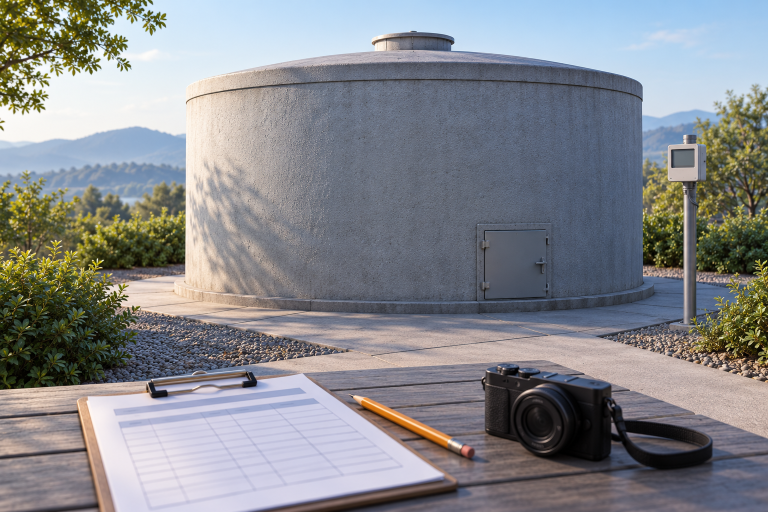
Find the original drawings, purchase documents, installation instructions and any later repair records. Record the manufacturer, model, material, capacity and installation date where known. For a site-built tank, look for its design and construction records. Keep unknowns marked as unknown rather than identifying a buried tank from the access lid alone.
Different products can have different empty-tank restrictions, even within one manufacturer’s range. Norwesco’s Legacy cistern information says its ribbed tanks of 600 gallons and larger must remain at least one-quarter full, while the linked installation sheet separately addresses maintenance pump-outs and refilling. Its Low Profile cistern information allows dry pump-outs. These are product-specific statements, and permission for a pump-out does not establish how long a tank may remain empty for rehabilitation. Ask the manufacturer and responsible professional to resolve which instructions and conditions apply to the identified tank and proposed work.
Do not transfer instructions between tank families or assume that a tank suitable for water storage is suitable for an interior coating. The same Legacy product information says those polyethylene tanks require no additional coating. Any proposed rehabilitation must first be appropriate for the actual tank and approved scope.
Ask about the surroundings as well as the shell
The review needs to consider the installed tank, not just an isolated product specification. Provide available information about burial depth, soil, drainage, groundwater, nearby loading and any anchoring or ballast shown on the drawings. Tell the reviewer about recent flooding, unusually wet ground, excavation nearby or changes to pavement and drainage.
Groundwater and empty-tank stability are real design considerations. For example, the Town of Stow’s 2025 fire-cistern project specifications require an installation that will not float when empty and call for buoyancy calculations where groundwater is a problem. That is a project-specific example, not a design prescription for another property.
Tank-wall limitations also vary. The installation instructions linked for Norwesco’s Legacy range prohibit installation in saturated clay or a high water table because of collapse risk. A lining product’s adhesion or waterproofing claim does not answer whether an existing tank can withstand the planned outage conditions.
Turn the review into a written work boundary
Ask the responsible professional to identify whether lowering the water level is acceptable, what conditions apply and who will supervise the work. A useful response should address the specific tank and proposed job rather than simply say that the contractor has emptied tanks before.
Questions to resolve include:
- What documents establish the tank’s permitted empty or partly empty condition?
- Does the installation need additional assessment before a decision can be made?
- What water-level restrictions and duration limits apply to this job?
- Which weather, groundwater or site changes require the plan to be reassessed?
- Who can pause the work, and who authorizes the next stage?
Record the answer and its date with the scope. If original records are missing, ask what investigation is needed. Do not replace missing evidence with an owner-devised pumping rate, an assumed safe water level or a plan to see whether the tank moves.
Keep empty-tank approval separate from entry approval
A tank being acceptable to empty does not make it acceptable to enter. OSHA’s confined-space overview identifies tanks among spaces that can present entry hazards. Assessment, isolation and entry arrangements belong with properly qualified personnel and the applicable safety program.
Do not open a cover, climb inside, reach through an opening or excavate around the tank to gather missing information. Obtain records from the installer or manufacturer and let the responsible professional determine how further inspection can be performed safely. Likewise, groundwater management and temporary structural measures are engineering and contractor decisions, not improvised owner tasks.
Resolve the conflict before booking the lining work
A proposed lining process may need an empty, prepared surface for longer than the tank’s existing instructions allow. Treat that mismatch as a reason to stop and obtain a revised professional plan. A quicker coating cure alone does not resolve restrictions during draining, cleaning, repairs and preparation.
Once the tank-specific plan is accepted, coordinate it with the temporary water supply, disposal arrangements and return-to-service requirements. Our cistern outage-planning guide addresses that separate continuity-of-supply task. Keep one named person responsible for confirming that the conditions still match the approved plan when work begins. The practical result is a clear decision about whether and how the tank can be taken out of service before anyone starts removing its water.
Researched owner-planning guidance, not a tank design, pump-out procedure or confined-space entry plan. Cover: AI-generated conceptual illustration.
Do this work for a living
Want to spray cistern liners?
ArmorThane equips and trains contractors to line cisterns, tanks and pipe with polyurea. Get the startup details in two minutes.