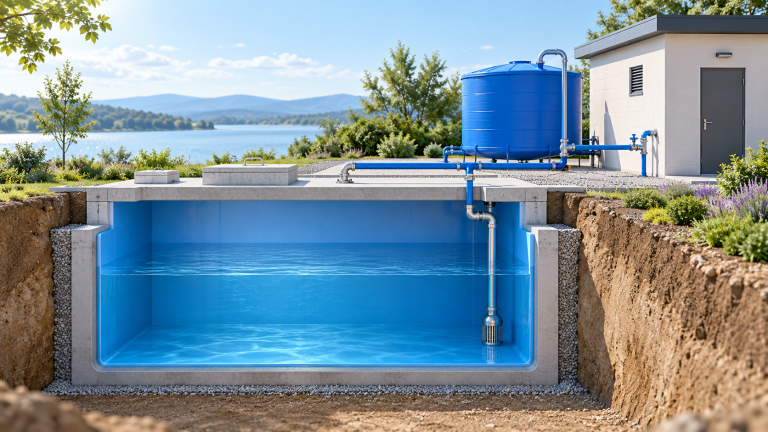
Cistern Coating Quantities: Start with Interior Surface Area
Estimate cistern lining materials from interior surface area, specified film thickness and realistic consumption allowances, with a worked tank example.
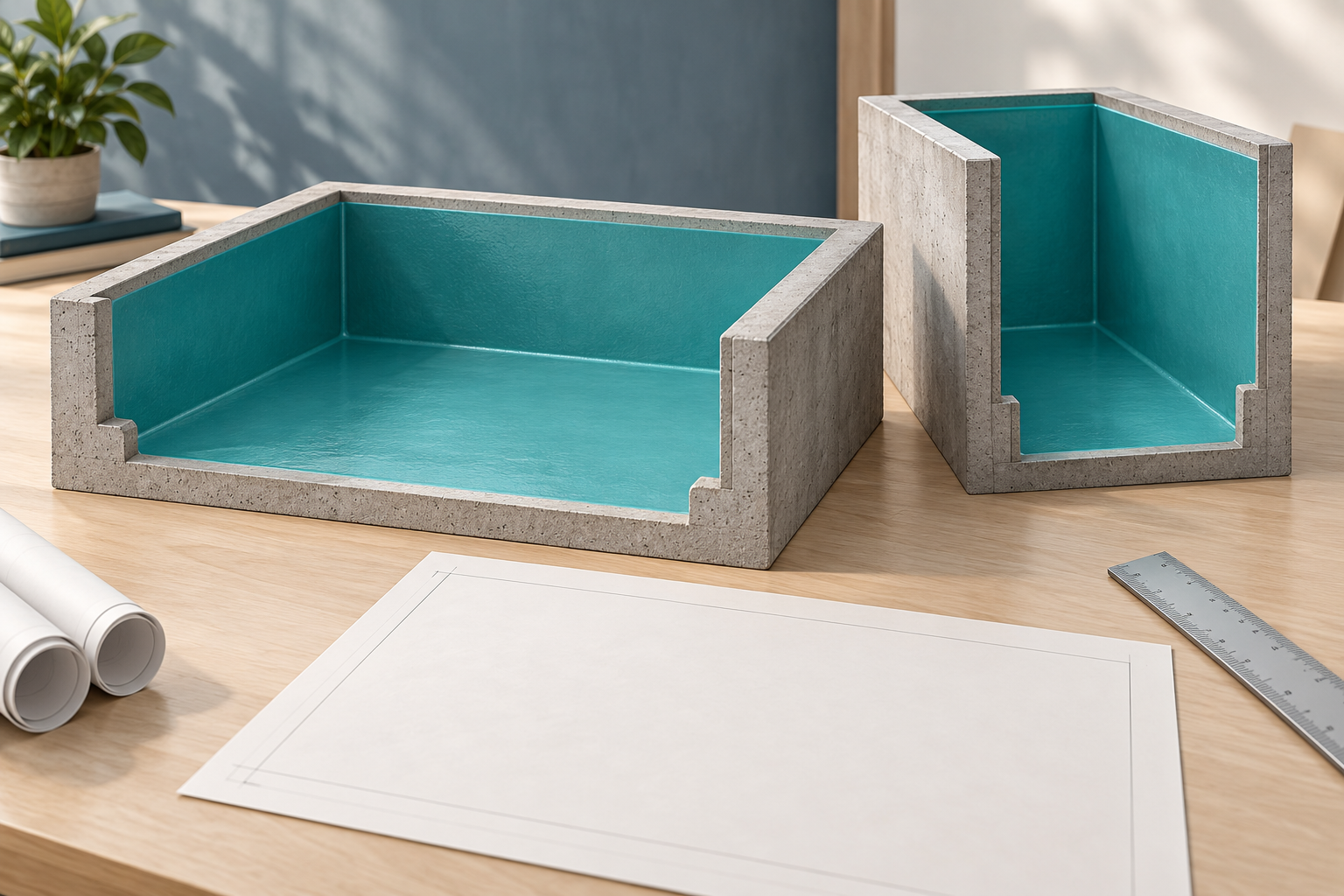
A cistern’s storage capacity is useful for water-supply planning. A coating estimate needs another measurement: the surface area included in the lining work. Two tanks that hold the same number of gallons can have different wall, floor and ceiling areas, so a price or material allowance based only on storage capacity can miss a substantial part of the job.
A useful quantity estimate connects three records: the interior dimensions, a clear list of surfaces receiving each material, and the specified coating system. Start there before comparing kit counts or coverage claims.
Define the surfaces before calculating area
Have a qualified estimator or design professional develop an area takeoff from current drawings, manufacturer records and appropriately verified dimensions. Identify internal measurements explicitly; exterior dimensions include the structure’s thickness and can overstate the available space. Record assumptions where drawings are incomplete or the existing tank differs from them.
The lining scope should identify:
- Floor and wall areas, including the full specified wall height.
- Ceiling or roof underside, if included in the system.
- Exposed faces of columns, beams, baffles and other internal features.
- Sumps, slopes, coves, penetrations and transitions requiring separate details.
- Surfaces excluded from coating and areas receiving a different material.
Do not assume that the normal waterline defines the coating boundary. Have the project specification resolve that question. Do not enter a cistern to collect measurements. Water tanks can present confined-space hazards; any necessary investigation belongs with qualified professionals operating under the applicable safety requirements. OSHA’s guidance on water-storage-tank work explains why these spaces require particular care.
Equal storage volume, different lining quantities
Consider two hypothetical rectangular tanks with flat floors and ceilings, no internal obstructions and dimensions measured inside:
- Tank A: 20 ft long × 10 ft wide × 6 ft high. Floor: 200 ft². Walls: 360 ft². Ceiling: 200 ft². Full interior total: 760 ft².
- Tank B: 30 ft long × 10 ft wide × 4 ft high. Floor: 300 ft². Walls: 320 ft². Ceiling: 300 ft². Full interior total: 920 ft².
Both have a geometric volume of 1,200 ft³, approximately 8,977 US gallons using NIST’s unit conversions. That is gross geometric volume, before operating-level limits or displacement. Yet Tank B has about 21% more interior area when all six faces are included.
For this simple shape, floor area is length × width, wall area is 2 × height × (length + width), and a flat ceiling adds another length × width. Real shapes and internal features need their own geometry. If ceilings are excluded, these examples become 560 ft² and 620 ft²; the written scope changes the answer.
Turn area into theoretical coating volume
Next, use the exact product data and required dry-film thickness for each coat. Volume solids describes how much of the liquid coating volume remains as solid film. Use volume solids rather than weight solids, as explained in DeFelsko’s film-thickness guidance.
The common US-unit relationship is:
Theoretical coverage (ft²/US gal) = 1,604 × volume-solids fraction ÷ dry-film thickness (mils).
Here, 80% is entered as 0.80, and one mil is 0.001 inch. The rounded constant follows from spreading one US gallon, 231 cubic inches, into a one-mil layer. For metric estimates, Hempel’s theoretical spreading-rate calculator uses volume solids (%) × 10 ÷ thickness (micrometres), giving m²/L.
Purely for illustration, a hypothetical 80%-volume-solids coating at 20 mils dry gives 1,604 × 0.80 ÷ 20 = 64.16 ft²/US gal. Covering Tank A’s 760 ft² once would theoretically require 760 ÷ 64.16 = approximately 11.85 US gallons. These assumed values are arithmetic examples, not a product, thickness or potable-water recommendation. The specified system determines the actual values.
Account for the whole system and practical consumption
Theoretical coverage assumes ideal spreading. Hempel’s consumption guidance identifies surface roughness, geometry, film variation and physical losses as reasons practical consumption differs. A textured substrate, material left in equipment, overspray and locally heavier application can all affect the order quantity. Even a 100%-solids product needs a job-specific practical allowance.
Calculate primers, specified lining coats and local detailing materials separately. Include profile-filling or resurfacing products where specified, rather than hiding them inside the finish-coat allowance. Avoid counting the same allowance twice. State whether an adjustment is a consumption multiplier or a percentage of material lost; those conventions produce different arithmetic.
For multi-component products, confirm the mixed yield of each supplied kit and the required component quantities with the manufacturer. Round purchasing quantities to available packaging after estimating each material. A stated number of gallons should clearly identify mixed material, individual components or usable packaged yield.
Ask for an estimate you can check
A reviewable proposal should show the area takeoff, included surfaces, product and coat schedule, thickness basis, theoretical quantity, practical allowances and final package count. Keep the drawing revision alongside those figures so changes are traceable. For more background on the coverage calculation, see Volume Solids & Coverage Explained.
Researched planning guidance. Follow the specified system, applicable requirements and current manufacturer instructions. Cover: original AI-generated illustration, not a site inspection or product test.
Do this work for a living
Want to spray cistern liners?
ArmorThane equips and trains contractors to line cisterns, tanks and pipe with polyurea. Get the startup details in two minutes.