

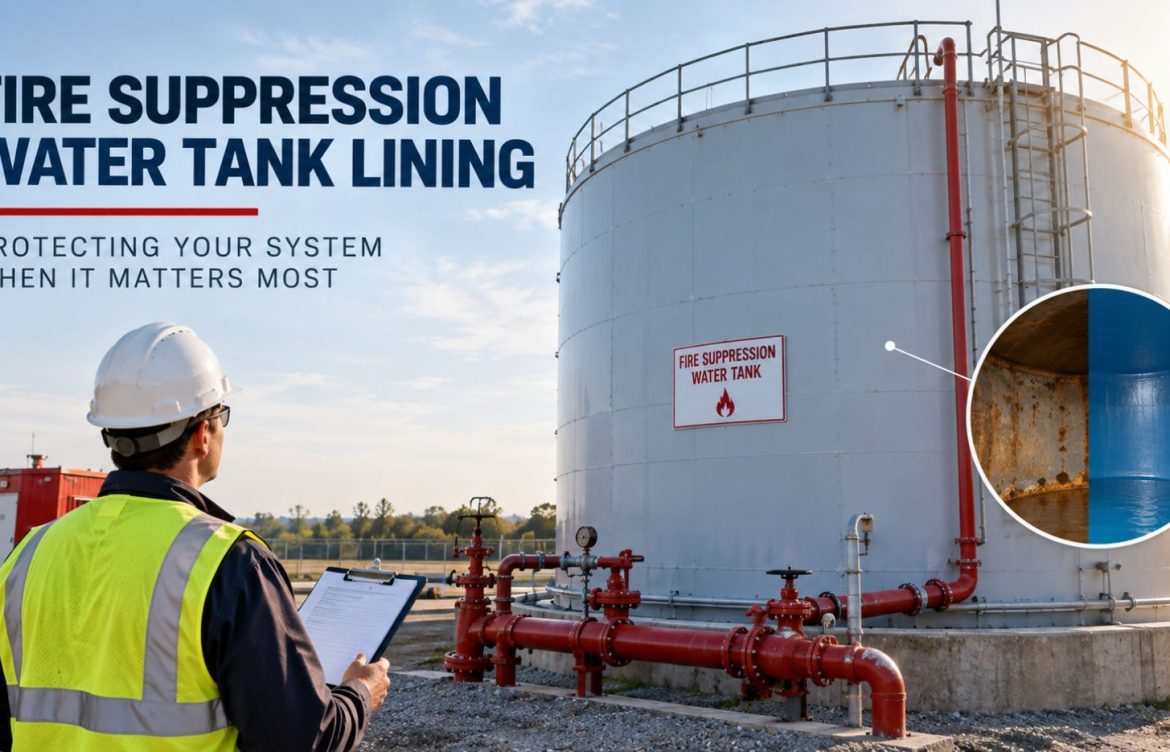
Lining Fire Suppression and Standby Water Tanks
A fire suppression water tank has one job, and for most of its life, it does that job by sitting completely still. Unlike a drinking water cistern or a municipal reservoir that sees regular turnover as water is drawn out and replenished, a standby fire protection tank can sit essentially untouched for months or years at a time, waiting for an emergency that, hopefully, never comes. That stillness sounds like it should be easy on the tank. In practice, it creates a corrosion environment that’s genuinely different from, and in some ways worse than, what a regularly used water storage tank experiences, which is exactly why fire suppression water tank lining deserves its own conversation rather than being treated as a smaller version of a standard water tank project.
This guide covers what makes fire protection tanks different, why stagnant water is such a specific corrosion problem, and what actually goes into lining or relining one of these systems correctly.
Why Stagnant Water Is Harder on a Tank Than Flowing Water
It seems counterintuitive at first. Water sitting still isn’t wearing away at anything the way moving water might erode a surface, so why would a fire tank corrode faster than a tank with regular turnover? The answer has more to do with chemistry and biology than mechanical wear.
Stagnant water allows dissolved oxygen levels, mineral concentrations, and microbial activity to settle into a stable, often more corrosive equilibrium than water that’s constantly being refreshed. Microbiologically influenced corrosion, where bacteria colonize a steel tank’s interior surface and create localized corrosion cells, thrives specifically in the kind of low-flow, low-oxygen-turnover conditions that describe a standby fire tank almost perfectly. This isn’t a hypothetical risk, it’s a well-documented issue in the fire protection industry, and it’s part of why a steel fire tank that’s never been properly lined or maintained can show significant pitting corrosion well before a comparably aged, regularly used water tank would.
What Makes Fire Suppression Water Tank Lining a Different Project
Beyond the stagnant water issue, fire protection tanks come with a few other characteristics that shape how a lining project needs to be planned.
Access for inspection and maintenance is often more limited than for a municipal reservoir, since fire tanks aren’t part of a facility’s daily operational routine the way a process water tank or drinking water supply would be. That means problems can go unnoticed longer simply because nobody’s looking at the tank regularly, which raises the stakes on getting a thorough assessment done whenever the tank finally does get inspected or relined.
Some fire protection tanks serve a dual purpose, providing both fire suppression reserve and a potable water supply, while others are dedicated entirely to fire protection with no potable use at all. This distinction matters enormously for certification requirements, covered in more detail below, since treating every fire tank as though it needs potable water certification, or assuming none of them do, is a mistake in either direction depending on the specific tank’s actual function.
Certification: A Genuinely Different Question Than for Drinking Water
This is where fire suppression water tank lining diverges most clearly from residential or municipal drinking water projects. If a tank is dedicated purely to fire protection, with no potable water function, NSF/ANSI 61 certification, the standard required for materials in contact with drinking water, generally doesn’t apply in the same way, since that certification specifically addresses health effects from materials contacting water intended for human consumption. Our explainer on what NSF/ANSI 61 certification actually covers goes into detail on what that standard specifically tests for and why it’s scoped to potable use.
That doesn’t mean a fire protection tank lining has no relevant standards or listing requirements at all. Fire protection system components, including in some cases the tanks and their linings, may need to meet requirements set by recognized listing organizations and align with NFPA standards governing private fire protection water tanks. Confirming the specific applicable requirements for a given jurisdiction and system design with a fire protection engineer or authority having jurisdiction is the right step here, rather than assuming either that no standards apply or that the same potable water certification used for a drinking water cistern automatically covers a fire protection application.
For tanks serving a genuine dual purpose, both fire suppression and potable supply, the potable water certification requirement absolutely does apply to whatever portion of the system contacts water intended for consumption, and that verification needs to happen with the same rigor as any purely drinking water project.
Assessing a Fire Tank Before Relining
A proper assessment for a fire suppression tank needs to account for the fact that corrosion may be more advanced than a similar-aged, regularly used tank would show, given the stagnant water conditions covered above. Ultrasonic thickness testing at multiple points, rather than relying on visual inspection alone, is particularly important here, since MIC-related pitting can create localized wall thinning that’s easy to miss without direct measurement, even when the surrounding tank surface looks relatively sound.
Our broader piece on water tank rehabilitation, covering assessment, prep, and return to service, walks through the general assessment and preparation sequence that applies here too, though a fire tank assessment should specifically account for the elevated corrosion risk that comes with extended stagnant periods rather than assuming standard wear patterns.
For concrete fire protection tanks, structural cracking needs the same attention it would in any other concrete water storage structure. Our guide on repairing cracked concrete water tanks before lining applies directly here, since coating over unrepaired structural cracks in a fire tank creates the same repeat-failure risk it would in any other tank type.
Lining Considerations Specific to Standby Service
A lining chosen for a fire suppression tank needs to hold up under the specific conditions that standby service creates, extended stagnant contact, potential for MIC activity at the coating-substrate interface if surface preparation wasn’t thorough enough, and long periods with no visual monitoring between formal inspections. This argues for a lining system with genuinely strong, well-documented performance under stagnant water conditions specifically, not just general water resistance claims.
Surface preparation before lining deserves the same rigor here as in any tank rehabilitation project, arguably more given how much MIC-related pitting can hide beneath what looks like a sound surface. Our piece on cistern liner repair and relining covers surface preparation fundamentals that apply across tank types, including the standby fire protection tanks covered here.
Fire Protection Tank vs. Drinking Water Tank Comparison
| Factor | Fire Suppression Tank | Drinking Water Tank |
|---|---|---|
| Water turnover | Minimal, often stagnant for extended periods | Regular, ongoing draw and refill |
| Corrosion risk profile | Higher risk of MIC and localized pitting | Lower, but still present over time |
| Certification requirement | Generally not NSF/ANSI 61 unless dual-purpose | NSF/ANSI 61 required for potable contact |
| Applicable standards | NFPA and relevant listing requirements | NSF/ANSI 61, state/local drinking water codes |
| Inspection frequency | Often less frequent, lower daily visibility | Typically more routine, operationally visible |
Things to Consider Before Relining a Fire Suppression Tank
- Is this tank dedicated purely to fire protection, or does it also serve a potable water function that changes the applicable certification requirements?
- Has the assessment accounted for the elevated MIC and pitting corrosion risk associated with extended stagnant water conditions, rather than assuming standard wear patterns?
- Has ultrasonic thickness testing been performed at multiple points, given how localized pitting can hide beneath an otherwise sound-looking surface?
- Does the lining system have documented performance specifically under stagnant water conditions, not just general water resistance claims?
- Have the applicable NFPA standards and any relevant listing requirements for this jurisdiction and system been confirmed with a fire protection engineer or the authority having jurisdiction?
Maintenance and Inspection Going Forward
Because fire suppression tanks don’t get the same daily operational attention a drinking water system does, building a deliberate periodic inspection schedule matters more here than it might for a more visible system. Checking for early signs of coating wear, monitoring water quality where practical, and keeping documentation of the original lining specification and any certification details on file all support both ongoing tank integrity and regulatory compliance in a system that otherwise might not get looked at again for a long time.
Frequently Asked Questions
Do fire suppression water tanks need NSF/ANSI 61 certified linings?
Generally not, if the tank serves fire protection exclusively with no potable water function, since NSF/ANSI 61 specifically addresses materials in contact with water intended for human consumption. Dual-purpose tanks serving both fire protection and potable supply do need certification for the potable-contact portion.
Why do fire tanks corrode more than expected given how little they’re used?
Stagnant water creates favorable conditions for microbiologically influenced corrosion and allows mineral and chemical concentrations to settle into a more corrosive equilibrium than regularly turned-over water, which is counterintuitive but well documented in the fire protection industry.
How often should a fire suppression tank be inspected?
This depends on applicable NFPA standards and local requirements, but given the lower daily visibility of these systems compared to operational water tanks, a deliberate, scheduled inspection routine matters more than it might for a more actively monitored system.
Can the same lining product used for a drinking water cistern be used in a fire suppression tank?
Possibly, but the certification and performance requirements differ, so a product’s suitability should be confirmed against the specific application’s actual requirements rather than assumed to transfer directly from one use case to another.
What’s the biggest risk in a fire suppression tank rehabilitation project?
Underestimating corrosion severity due to the tank’s stagnant service history, which can lead to an assessment that misses localized pitting a more thorough, measurement-based inspection would have caught.
Conclusion
Fire suppression water tank lining isn’t a smaller or simpler version of a drinking water tank project, it’s a genuinely different problem shaped by stagnant water conditions that create their own corrosion risks and a certification landscape that doesn’t automatically mirror potable water requirements. Getting the assessment thorough enough to catch hidden pitting, choosing a lining proven under stagnant conditions specifically, and confirming the actual applicable standards for the tank’s real function are what separate a fire protection system that’s ready when it’s needed from one that’s quietly deteriorating behind a wall nobody’s opened in years.